Fraud is a big, scary term that can easily cause merchants to panic. However, if the risk is broken down and analyzed more carefully, merchants will realize there are only three types of fraud they need to worry about.
Gauging the risk and repercussions associated with fraud is challenging. To better understand how the three types of fraud impact a business, it is best to analyze each according to chargeback rates.
Chargeback rates are a reliable measurement tool because the vast majority of a business’s payments are facilitated with a debit or credit card. A recent study revealed 80% of purchases (both in-person and online) were made with payment cards.
As eCommerce continues to grow, the dependence on credit and debit cards will only increase. Between 2014 and 2015, eCommerce sales increased 14.4%. All retail, brick-and-mortar and eCommerce combined, only saw a 0.9% jump in the same time period.
All credit and debit card transactions are eligible for chargebacks. Therefore, this reliance on payment cards subjects businesses to both fraud and the resulting chargebacks.
Threat #1: Fraud Committed By Criminals
Criminal activity is what most merchants associate with the term fraud. Criminals gain access to credit card information and make unauthorized purchases. This type of fraud is commonly associated with identity theft.
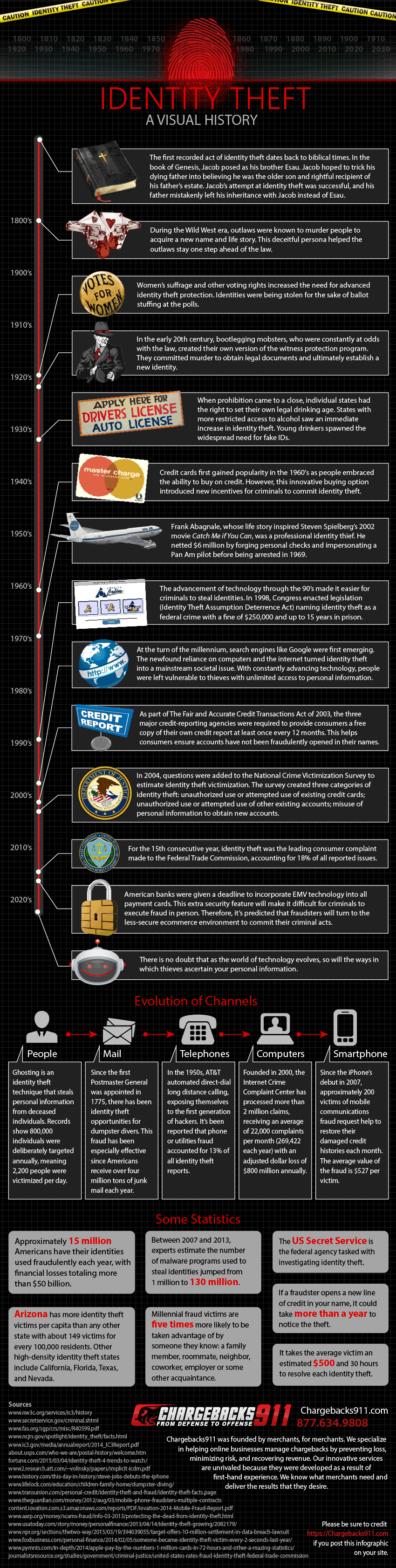
Identity theft isn’t a new topic. In fact, the criminal act dates back centuries.
Perhaps the long history of identity theft is why many businesses place such a strong emphasis on preventing this type of fraud. A careful look at past and present techniques shows fraudsters are capable of adapting their identity theft tactics to what is best suited for modern situations.
This ever-evolving threat keeps merchants on their toes and makes businesses assume they are constantly in danger of attacks.
In reality, criminal fraud is a relatively low risk for most businesses. For the average merchant, only 1-10% of all chargebacks are attributed to unauthorized transactions caused by criminal activity. That means there are greater fraud risks to be aware of.
Threat #2: Fraud Committed by Merchants
Most businesses never consider the fact that they are their own worst enemies. While this type of fraud is usually unintentional, it can still harm a business’s bottom line.
Unless business owners are setting out with the intention of robbing the consumer, this type of fraud is usually caused by merchant errors and oversights.
Examples of merchant errors that are considered fraud include:
• Charging a card more than once for the same transaction
• Charging a transaction amount that differs from what the consumer agreed to
• Failing to issue credits and cancellations in a timely fashion
• Insufficiently describing the merchandise or services
• Not fully disclosing the policies and terms of service
Merchants might think themselves blameless, but their actions cause more damage than they’re aware. Between 20% and 40% of an average merchant’s chargebacks are attributed to merchant error.
Threat #3: Fraud Committed by Consumers
By far, the greatest risk businesses are exposed to comes from their very own customers.
Consumers are stealing from merchants, engaging in cyber shoplifting, with a tactic called friendly fraud. After participating in the purchase and authorizing the transaction, consumers turn around and dispute the validity of the credit card charge.
These fraudulent consumers will use any means necessary to file illegitimate chargebacks with the bank. While some customers set out with the intention of getting something for free, the majority of cardholders engage in fraud out of convenience; it’s easier to contact the bank for a chargeback than obtain a refund from the merchant.
In the end, 60-80% of chargebacks are cases of friendly fraud, making fraud from consumers the biggest threat businesses face.
As a small business owner, Monica Eaton-Cardone nearly succumbed to unmanageable fraud and the resulting chargebacks. After finding a solution that worked for her own business, Monica co-founded Chargebacks911™ to share her successful strategy with other merchants. Now, Monica serves as COO and specializes in helping merchants ensure sustainable growth through friendly fraud management, chargeback prevention, and risk mitigation.
Choosing the right business structure is an important step for entrepreneurs, especially when deciding between…
Running a business from home is a dream for many, but it does come with…
When you first started your business you probably had an idealistic view of how everything…
Before you start a business in California, you need to choose the right business entity…
You need a business license to operate and legalize your business in the United States…
An LLC (limited liability company) is a common way to organize a business in the…